

 Posts
Posts


It's hard to believe that I've been here three weeks and have heard NO drumming. The wedding we attended last Sunday was to have it, but it turned out that there had been a funeral in the family during the week, so the music was cancelled.
Tomorrow will be my first real kora lesson with PaBobo. Then in the evening I'll be hearing his group perform. Maybe you'll see a video of it next week or after Ken gets ahold of it.
There really isn't any music in the village where I live. Can't believe it.
The internet is being really weird and I just lost a whole post about how they deal with trash. This is just a warning that there may be no more this weekend. Sorry.
Friday, February 6, 2009

Sunday, February 1, 2009
An idea of the School
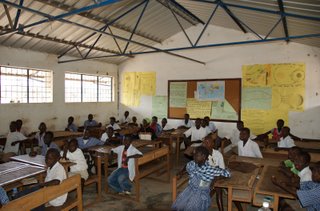
I've spent the last week observing the teaching at the Makumbaya Lower Basic School. I'm amazed. Most teachers are terribly dedicated, but half untrained. The class sizes are outrageous; from 33 to 47. Last year half the class came in the morning and half in the afternoon, but the government said that unless there are more than SIXTY students in the class, that would not be allowed!!!! Can you imagin 45 first graders? How in the world can you teach that many students the basic of reading and math. My job is to come up with techniques. If any of you want to suggest one, please do.
The children come to school at 9 and at 11:30 have a half hour break where mothers sell food. Most children have a couple dalasis to purchase. I pity those that don't, but can't help them. At noon they go back in for another hour instruction. Then there are a few third and fifth grade students whose parents can pay 15 dalasis a month for further instruction from two to four.
There is also an advanced placement class for the best of the sixth grad and they're testing now for the fifth grade class. On Friday I began the folktale to drama road with the sixth by reading Anansi and the Tug-of-War.
Twice a week the students begin their day by standing in line for A HALF HOUR for assembly. THat's the time the deputy tells them about being on time and studying hard. It's incredibly boring and of course as far as being on time he's "preaching to the choir" since the late comers aren't their yet. I just can't imagine US students successfully doing that!
Corporal punishment is legally not allowed, but it happens anyhow. I don't condone it, but how can untrained individuals, or even trained teachers handle so many students for such long times without having a bit of fear instilled in them . It's part of their life and it surprises me that the children are still enthusiastic about learning. They still volunteer to go to the board even though if what they write in incorrect, instead of being aided to succeed, they'll be told, "Wrong! Take your seat. Don't waste our time!" (I've heard those words in at least six classrooms!) I'm hoping to instill in the teachers the idea of "positive reinforcement" by the time I leave.
As I was told, there are few supplies other than chalk and a piece of sponge to erase and a book for the teacher. When there are student texts, there are only a few. I observed a reading lesson in a fifth grade of 45 students who had nine texts. THey did group so five were sharing each book, but two were trying to read up-side down. Then there was the first grade with 45 students and nine books where the teacher gave a book to 9 individual students and the others didn't even have a chance to see. This truly is an emense challenge.
Well, on the positive side, so far, suggestions seem to be appreciated and several teachers have used them. Hope it lasts.
Many more things to tell, but time is running out. Loving life here, challange after challange.
The children come to school at 9 and at 11:30 have a half hour break where mothers sell food. Most children have a couple dalasis to purchase. I pity those that don't, but can't help them. At noon they go back in for another hour instruction. Then there are a few third and fifth grade students whose parents can pay 15 dalasis a month for further instruction from two to four.
There is also an advanced placement class for the best of the sixth grad and they're testing now for the fifth grade class. On Friday I began the folktale to drama road with the sixth by reading Anansi and the Tug-of-War.
Twice a week the students begin their day by standing in line for A HALF HOUR for assembly. THat's the time the deputy tells them about being on time and studying hard. It's incredibly boring and of course as far as being on time he's "preaching to the choir" since the late comers aren't their yet. I just can't imagine US students successfully doing that!
Corporal punishment is legally not allowed, but it happens anyhow. I don't condone it, but how can untrained individuals, or even trained teachers handle so many students for such long times without having a bit of fear instilled in them . It's part of their life and it surprises me that the children are still enthusiastic about learning. They still volunteer to go to the board even though if what they write in incorrect, instead of being aided to succeed, they'll be told, "Wrong! Take your seat. Don't waste our time!" (I've heard those words in at least six classrooms!) I'm hoping to instill in the teachers the idea of "positive reinforcement" by the time I leave.
As I was told, there are few supplies other than chalk and a piece of sponge to erase and a book for the teacher. When there are student texts, there are only a few. I observed a reading lesson in a fifth grade of 45 students who had nine texts. THey did group so five were sharing each book, but two were trying to read up-side down. Then there was the first grade with 45 students and nine books where the teacher gave a book to 9 individual students and the others didn't even have a chance to see. This truly is an emense challenge.
Well, on the positive side, so far, suggestions seem to be appreciated and several teachers have used them. Hope it lasts.
Many more things to tell, but time is running out. Loving life here, challange after challange.
Saturday, January 24, 2009
More Compound Experiences
Before I came, I found a place called Couch Surfing where travelers can find someone to meet in a country or even to stay with. I began corresponding with a 32 year old teacher with a wife and three children. Today, I met him and without his help, I would have had a lot more difficulty posting these blogs. He really knows his way around the technology here. (Don't worry Ken. I doubt he has had the opportunity to learn and experience all you have.)
Lamin met me at the gellah gellah garage with his friend Kabo who, luckily for me, has a car. We went to Lamin's compound where, not only did I meet his family, but his wife, Maddy had made the most delicious domada I've had. (A far cry from mine, for those who've tasted it!) It's most interesting to compare it to the four or five times I've had it in Makumbaya. It was rich tasting and probably had a whole chicken in it. In Makumbaya, there has never been any meat. I think it shows the economy of the two families. Here I ate from a common bowl with spoons. I was joined only by the three men. When the visitors left, Matty and the children joined in. It was a lovely affair.
Lamin took me to a Western Union which is the only place open after noon Saturday where you can get money. VISA is no longer effective in the Gambia!!! Thanks, Rough Guide for telling me it's the best way to get money! Western Union is supposed to be the lowest rate, but instead I received 26,000 dalasi instead of the 22,000 on my first day.
Now we're back at the Internet Cafe where he knows everyone (works here part time) and we've had attaya. (That might be spelled wrong, but it's the super strong green tea with tons of sugar.) From here we're going to here music from Guinea. I met the drummer at Lamin's compound earlier today. Unfortunately, music doesn't start until midnight, so I'll be bushed tomorrow. Luckily I can attend because I have a ride home.
Lamin met me at the gellah gellah garage with his friend Kabo who, luckily for me, has a car. We went to Lamin's compound where, not only did I meet his family, but his wife, Maddy had made the most delicious domada I've had. (A far cry from mine, for those who've tasted it!) It's most interesting to compare it to the four or five times I've had it in Makumbaya. It was rich tasting and probably had a whole chicken in it. In Makumbaya, there has never been any meat. I think it shows the economy of the two families. Here I ate from a common bowl with spoons. I was joined only by the three men. When the visitors left, Matty and the children joined in. It was a lovely affair.
Lamin took me to a Western Union which is the only place open after noon Saturday where you can get money. VISA is no longer effective in the Gambia!!! Thanks, Rough Guide for telling me it's the best way to get money! Western Union is supposed to be the lowest rate, but instead I received 26,000 dalasi instead of the 22,000 on my first day.
Now we're back at the Internet Cafe where he knows everyone (works here part time) and we've had attaya. (That might be spelled wrong, but it's the super strong green tea with tons of sugar.) From here we're going to here music from Guinea. I met the drummer at Lamin's compound earlier today. Unfortunately, music doesn't start until midnight, so I'll be bushed tomorrow. Luckily I can attend because I have a ride home.
My First Week
Gambia is an incredible trip! The people are so friendly and helpful, I see why it's advertised as "The Smiling Coast."
The acomodations in Makumbaya are not exactly as shown in Meagan's blog. I have a private drop loo, but if I want to go at night, I have to unlock my door and walk around a building and a bunch of other things, remove a stick that holds the tin and wood door closed and be sure to have water with me. Not bad, just unanticipated. \
In living in the compound, I see a huge strength of the country. The extended family is wonderful to observe. There are five young mothers, three fathers and ten children. The oldest three go to nursery school. Watching the family interact is such a treat. Although I am fed in a separate bowl and given a spoon, the rest of the women and children gather around one huge bowl on the ground. Most use their right hand to eat. It's a site to observe. The chickens are nearby to clean up any of the rice that falls. Yes, there's rice and rice and rice. I must admit though, I've enjoyed every Gambian dish that I've had. I didn't enjoy eating the bones of the fish, although it was alright to drop then on the ground for the animals.
The gellah-gellah are amazing. I have traveled on them anytime I've gone to or from Makumbaya. They are vans that are licensed for 22 people. So far I only seen 18 plus a few babies. Each one has an apprentice who controls the door and collects money. Often the doors keep coming open. It's totally amazing that people don't get hurt. At the same time riding in them is a joy. They wait to leave until there are "enough" passengers. Then they also pick up along the way. Sometimes it's things they're also picking up, like the time it stopped at a quarry. We waited while they filled three huge bags with zigon. I don't know the spelling or the use except that it's edible, but pregnant women shouldn't eat it. I tried it and it seem tasteless, so there must be a reason to consume it.
The school where I'll be working has huge classes, but they are really energetic and well behaved. The Jolly Phonics are sung with gusto. Unfortunately, usually I can't understand the words. For those of you who know me, you know how difficult accents are for me to understand. On top of that, these are children learning a third, fourth or fifth language! I'm actually impressed with what I've seen teaching wise, but I haven't seen much. I'll be observing and making suggestions beginning next week. This week, I'll be teaching a spelling exercise that will allow everyone to continually be taking part and give every student many times to hear the correct spelling.
Music-wise, I've had two incredible experiences. Both are meeting the top kora players in their compounds. At Jaliba Kuyateh's compound, I met him and listened to a practice. (More details later) Today, I visited with Malamini and PaBobo Jobarteh. I will be taking lessons from PaBobo and learning local stories from his dad, Malamini. I continue to find it amazing that you can actually interact with the top performers.
Next time I get to the internet, I hope to have my entry on a thumb drive as well as photos.
The acomodations in Makumbaya are not exactly as shown in Meagan's blog. I have a private drop loo, but if I want to go at night, I have to unlock my door and walk around a building and a bunch of other things, remove a stick that holds the tin and wood door closed and be sure to have water with me. Not bad, just unanticipated. \
In living in the compound, I see a huge strength of the country. The extended family is wonderful to observe. There are five young mothers, three fathers and ten children. The oldest three go to nursery school. Watching the family interact is such a treat. Although I am fed in a separate bowl and given a spoon, the rest of the women and children gather around one huge bowl on the ground. Most use their right hand to eat. It's a site to observe. The chickens are nearby to clean up any of the rice that falls. Yes, there's rice and rice and rice. I must admit though, I've enjoyed every Gambian dish that I've had. I didn't enjoy eating the bones of the fish, although it was alright to drop then on the ground for the animals.
The gellah-gellah are amazing. I have traveled on them anytime I've gone to or from Makumbaya. They are vans that are licensed for 22 people. So far I only seen 18 plus a few babies. Each one has an apprentice who controls the door and collects money. Often the doors keep coming open. It's totally amazing that people don't get hurt. At the same time riding in them is a joy. They wait to leave until there are "enough" passengers. Then they also pick up along the way. Sometimes it's things they're also picking up, like the time it stopped at a quarry. We waited while they filled three huge bags with zigon. I don't know the spelling or the use except that it's edible, but pregnant women shouldn't eat it. I tried it and it seem tasteless, so there must be a reason to consume it.
The school where I'll be working has huge classes, but they are really energetic and well behaved. The Jolly Phonics are sung with gusto. Unfortunately, usually I can't understand the words. For those of you who know me, you know how difficult accents are for me to understand. On top of that, these are children learning a third, fourth or fifth language! I'm actually impressed with what I've seen teaching wise, but I haven't seen much. I'll be observing and making suggestions beginning next week. This week, I'll be teaching a spelling exercise that will allow everyone to continually be taking part and give every student many times to hear the correct spelling.
Music-wise, I've had two incredible experiences. Both are meeting the top kora players in their compounds. At Jaliba Kuyateh's compound, I met him and listened to a practice. (More details later) Today, I visited with Malamini and PaBobo Jobarteh. I will be taking lessons from PaBobo and learning local stories from his dad, Malamini. I continue to find it amazing that you can actually interact with the top performers.
Next time I get to the internet, I hope to have my entry on a thumb drive as well as photos.
Friday, January 23, 2009
Jaliba Kuyateh - more details
While visiting in Brikama with Ebrima Sarr, my host, he took me to Jaliba's compound. We were met there by the drummer, Baba. Baba said that Jaliba's group would be practicing at four and that we should come back at 3:30. He also said that any musicians who were late to practice had to pay a fine.
We returned at 3:30 and had the pleasure of watching jeli children playing the instruments while the crew set up. I'll soon add photos if I can figure out how to do it. It was amazing how there were babies under a year who kept wanting to drum. Their mom's would take them to the three sabar and they would beat them with a stick. (Those drums are often played with one hand and one stick.)At least two of Jaliba's sons played the kora and sang. I had the pleasure of playing the balafon for a bit. Not West African tunes, just a couple originals.
Time passed and finally at five fifteen, Jaliba showed up! Guess the fine doesn't apply to him. He did go eat before he joined practice! The rehearsal reminded me of a few I've heard at home - Jeliba telling people how he'd like them to change what they were playing. Everyone was pleasant, no cross words, just men working together on four songs.
After hearing them, I see why people here consider Jaliba the top performer. He playes while he sings and dances and he is active in social causes.
We returned at 3:30 and had the pleasure of watching jeli children playing the instruments while the crew set up. I'll soon add photos if I can figure out how to do it. It was amazing how there were babies under a year who kept wanting to drum. Their mom's would take them to the three sabar and they would beat them with a stick. (Those drums are often played with one hand and one stick.)At least two of Jaliba's sons played the kora and sang. I had the pleasure of playing the balafon for a bit. Not West African tunes, just a couple originals.
Time passed and finally at five fifteen, Jaliba showed up! Guess the fine doesn't apply to him. He did go eat before he joined practice! The rehearsal reminded me of a few I've heard at home - Jeliba telling people how he'd like them to change what they were playing. Everyone was pleasant, no cross words, just men working together on four songs.
After hearing them, I see why people here consider Jaliba the top performer. He playes while he sings and dances and he is active in social causes.
Thursday, January 15, 2009
Griot - Jeli
I'd mentioned that there would be more about the term Griot. Rather than putting it in my own words before I visit the country, I'd rather quote from Eric Cherry, in his book, Mande Music. "The Maninka term Jeli (in Mandinka they are called Jalis) refers to a type of musical and verbal artist. Jelis are somewhat like the bards of old Europe. They are story teller, historians and musicians and yet more than this. Not just anybody can be Jeli. They are highly trained individuals and the skills are handed down through generations of specific families. Jelis have the exlusive right to play the kora, the bala (balafon) and the Koni. In certain areas Jelis also play the Jeli dundun and the tama. It is their role to sing and recount Mande social & politcal life.
They are praise singers and often encourage people to act. It is said that they can mould actions out or music in much the same way a blacksmith can mould useful things out of metal.
There are 3 fields of speciality for Jelis
* Speech (kuma) - This usually consists of history, stories, geneologies and proverbs.
* Song (Donkili) - Melodies and lyrics.
* Instrument playing (Maninka: foli, Mandinka: kosiri).
Each skill has completely different training and the end result is high specialisation whichever is chosen. Most males are skilled in 2 of these areas. Females are generally singers. Certain family names are Jeli, such as Cissokho, Koyate, Conte and Diabate." Others in The Gambia are Jobarteh, Susso, Suso, Saho, Kanuteh, Konte, & Konteh.
They are praise singers and often encourage people to act. It is said that they can mould actions out or music in much the same way a blacksmith can mould useful things out of metal.
There are 3 fields of speciality for Jelis
* Speech (kuma) - This usually consists of history, stories, geneologies and proverbs.
* Song (Donkili) - Melodies and lyrics.
* Instrument playing (Maninka: foli, Mandinka: kosiri).
Each skill has completely different training and the end result is high specialisation whichever is chosen. Most males are skilled in 2 of these areas. Females are generally singers. Certain family names are Jeli, such as Cissokho, Koyate, Conte and Diabate." Others in The Gambia are Jobarteh, Susso, Suso, Saho, Kanuteh, Konte, & Konteh.
Monday, January 12, 2009
Jolly Phonics
In my teaching of English to third through sixth grade, I've been asked to use a British program called Jolly Phonics. It contains a song that all of you probably learned in school. I'm trying to learn it this new way! Check it out.
Subscribe to:
Posts (Atom)